Palliative Care vs. Hospice: Understanding the Difference
Graceful Living Collective
When someone you love is living with a serious illness, words like palliative care and hospice can feel frightening.
Sometimes families hear either term and immediately think, “They’re giving up.”
But that isn’t what these types of care are about.
Both palliative care and hospice care focus on comfort, symptom management, quality of life, communication, and support for patients and families. The important difference is when these services are appropriate and what other treatment may continue at the same time.
Understanding that difference before your family is facing a crisis can make difficult decisions a little less overwhelming.
What Is Palliative Care?
Palliative care is specialized care for people living with a serious illness. Its goal is not necessarily to cure the illness, but to help the person live as well as possible while dealing with it.
It can address pain, shortness of breath, fatigue, nausea, anxiety, emotional distress, spiritual concerns, caregiver strain, communication with the medical team, and difficult decisions about treatment.
One of the biggest misconceptions is that accepting palliative care means stopping treatment.
It doesn’t.
Palliative care can begin at diagnosis, later in an illness, or anywhere in between. It can be provided at the same time as treatment intended to cure or control the disease.
Someone receiving chemotherapy for cancer, treatment for heart failure, or care for another serious illness may also receive palliative care to help manage symptoms, stress, and quality-of-life concerns.
Palliative care is based primarily on the person’s needs—not simply how long someone is expected to live.
Comfort, Communication, Choices and Control
One of my favorite concepts from my professional palliative-care education is the 4 C’s of Palliative Care:
Comfort. Communication. Choices. Control.
Those four words say a lot about what good palliative care should accomplish.
It isn’t only about controlling pain. It’s about asking: What matters to this person? What symptoms are making everyday life difficult? Does the patient understand the choices being presented? Does the family understand what is happening? Are we treating the person—or only treating the disease?
Palliative care takes a whole-person approach. Your physical health matters, but so do your emotional, social, and spiritual needs.
That philosophy is one reason I believe families should know about palliative care long before the final days of life.
So Then, What Is Hospice?
Hospice is a form of palliative care, but it is specifically focused on people approaching the end of life.
Hospice shifts the primary goal away from attempting to cure the terminal illness and toward comfort, dignity, and quality of life.
And I think the word living deserves emphasis here.
One of the ideas in my hospice education that has always resonated with me is that hospice is about living, not simply dying—managing symptoms and distress, having important conversations, maintaining quality of life, preparing for what is ahead, and giving people opportunities for closure.
Hospice isn’t intended to hasten death. It is intended to care for a person through the natural progression of terminal illness while also supporting the family.
Does Hospice Mean All Medical Care Stops?
No.
Choosing hospice does not mean, “We’re not treating Mom anymore.”
Treatment continues. The goal of treatment changes.
For someone using the Medicare hospice benefit, Medicare generally no longer covers treatment intended to cure the terminal illness or its related conditions through the regular Medicare benefit. Instead, the hospice benefit covers care directed toward comfort and management of the terminal illness and related conditions.
That can include medical and nursing care, medications for pain and symptom management, equipment and supplies, social-work services, spiritual support, and other services included in the individual’s hospice plan of care.
Medical care for conditions unrelated to the terminal diagnosis may still continue.
So “hospice means no treatment” simply isn’t accurate.
What About the Six-Month Rule?
You’ve probably heard that someone must have “six months to live” to receive hospice. That’s close, but it can be misleading.
For the Medicare hospice benefit, a physician must certify that the person is terminally ill with a life expectancy of six months or less if the illness follows its normal course.
That is a prognosis—not an expiration date.
A person can remain in hospice longer than six months if they continue to meet eligibility requirements and are appropriately recertified.
People can also improve or change their minds. Hospice isn’t an irreversible decision. Someone can revoke hospice and pursue disease-directed treatment again and, if eligible later, elect hospice again.
Where Does Hospice Happen?
Another common misconception is that hospice is a place you “go.”
Hospice is a type of care, not simply a building.
Depending upon a person’s circumstances, it may be provided in a private home, assisted-living community, nursing home, hospice facility, or hospital.
When hospice is provided at home, families should understand something important: hospice does not ordinarily mean that a hospice employee moves into the home to provide around-the-clock caregiving.
Family members and other caregivers generally provide much of the day-to-day care, while the hospice team visits, provides services and education, manages the plan of care, and offers support.
That’s an important conversation to have when deciding whether caring for someone at home is realistic.
Palliative Care vs. Hospice at a Glance
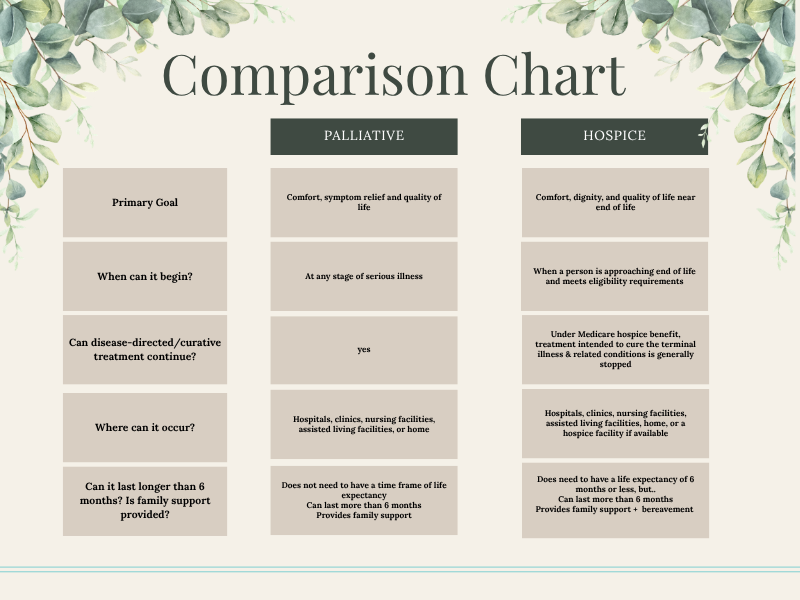
A comparison chart of palliative care versus hospice care for easy reference.
When Should You Ask About Palliative Care?
You don’t have to wait until someone is dying.
If a serious illness is causing difficult symptoms, repeated hospitalizations, declining function, caregiver stress, uncertainty about treatment choices, or simply a feeling that everyone is treating the disease while nobody is looking at the whole person, it may be worth asking:
“Would a palliative-care consultation be appropriate?”
The answer may be yes even while active treatment continues. Asking the question doesn’t commit you to anything. It simply opens another door.
When Might It Be Time to Talk About Hospice?
Hospice conversations become appropriate when an illness is progressing, treatments are no longer working as hoped or their burdens outweigh their benefits, life expectancy is becoming limited, or the person’s priorities are shifting primarily toward comfort and quality of life.
Unfortunately, families sometimes avoid the conversation because discussing hospice feels like abandoning hope.
But hope can change.
Hope may begin as: I hope we can cure this.
Later it may become: I hope we can control the pain. I hope Dad can stay home. I hope she can attend one more family celebration. I hope we can have the conversations we still need to have. I hope he feels safe, comfortable, and loved.
There can still be hope when the goal is no longer cure.
Ask Before the Crisis
This is probably the most important thing I want families to take from this article:
You don’t have to wait for a crisis to learn your options.
Ask questions early. What does my loved one want? What matters most to them if their health declines? What treatments would they—or wouldn’t they—want? Who should speak for them if they cannot speak for themselves? Would palliative care help us now? At what point would hospice become appropriate?
Those conversations can be uncomfortable. But having them at the kitchen table is very different from trying to answer them for the first time in an emergency room.
Planning doesn’t mean expecting the worst.
It means making thoughtful decisions before circumstances make them for you.
And that is a big part of living—and caring for the people we love—with grace.
Graceful Living Note
This article is intended for education and family planning, not individual medical advice. Palliative-care availability, hospice eligibility, and insurance coverage can vary. Talk with your healthcare team, hospice/palliative-care provider, and insurer about your individual circumstances.